Island Peak Climbing
From (per person)
Island Peak Climbing Highlights
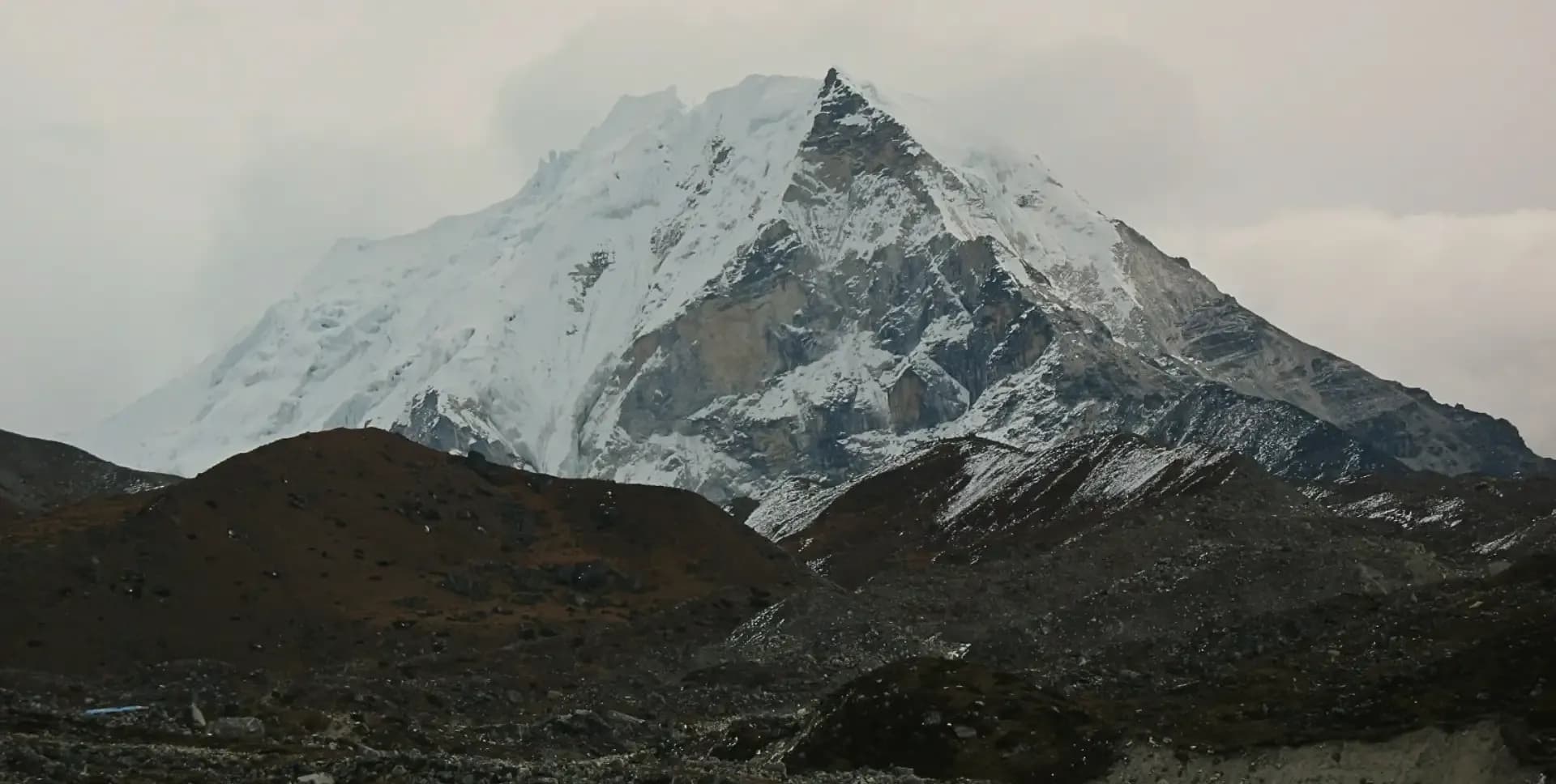
• Stand on the summit of Island Peak (Imja Tse), 6,189 m / 20,305 ft, one of the most rewarding trekking peaks in Nepal.
• Climb the fixed-rope headwall and summit ridge directly beneath the south face of Lhotse, with Nuptse, Makalu, Baruntse and Ama Dablam in view.
• Reach Everest Base Camp and watch the sun rise over Everest from Kala Patthar (5,545 m) before turning to the climb.
• Cross the remote Kongma La (5,535 m), the highest of the three Khumbu passes, on the way from Lobuche to Chukkung.
• Acclimatize step by step with day hikes to Hotel Everest View and Nangkartshang Peak and a full circuit of the upper Khumbu.
• Visit Tengboche Monastery, the spiritual heart of the Khumbu, and the seventeenth-century monastery at Pangboche.
• Practical climbing instruction from experienced climbing Sherpas before summit day, covering crampons, fixed ropes and the jumar.
Island Peak Climbing Overview
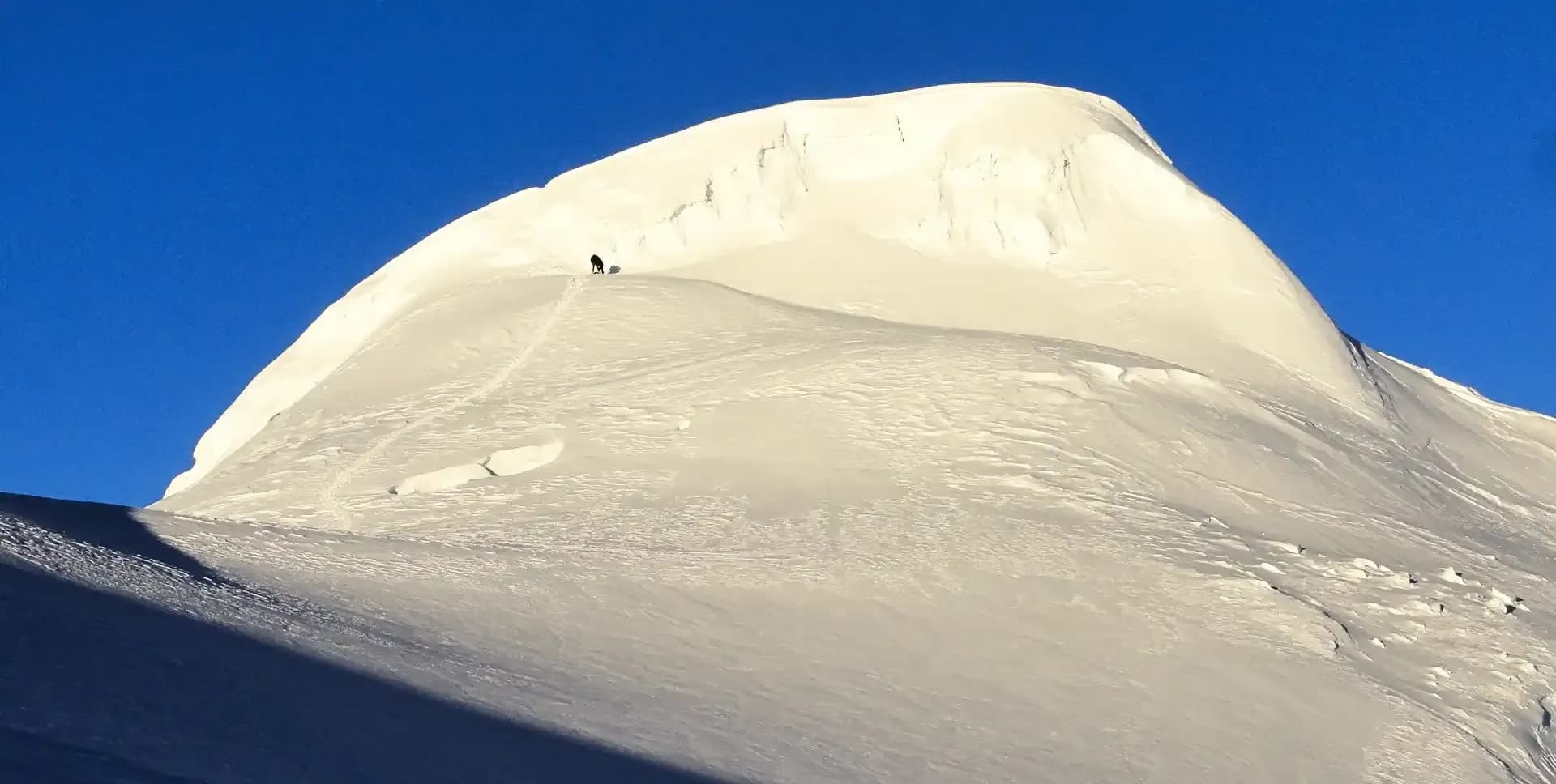
Island Peak, known locally as Imja Tse, rises to 6,189 m (20,305 ft) at the head of the Imja Valley in Nepal's Khumbu region. Eric Shipton's party named it in the early 1950s for the way it stands alone in a sea of glacial ice when seen from Dingboche. The peak is an outlier of the south ridge of Lhotse Shar, enclosed by the Lhotse and Imja glaciers, and is one of the most popular of Nepal's permitted trekking peaks.
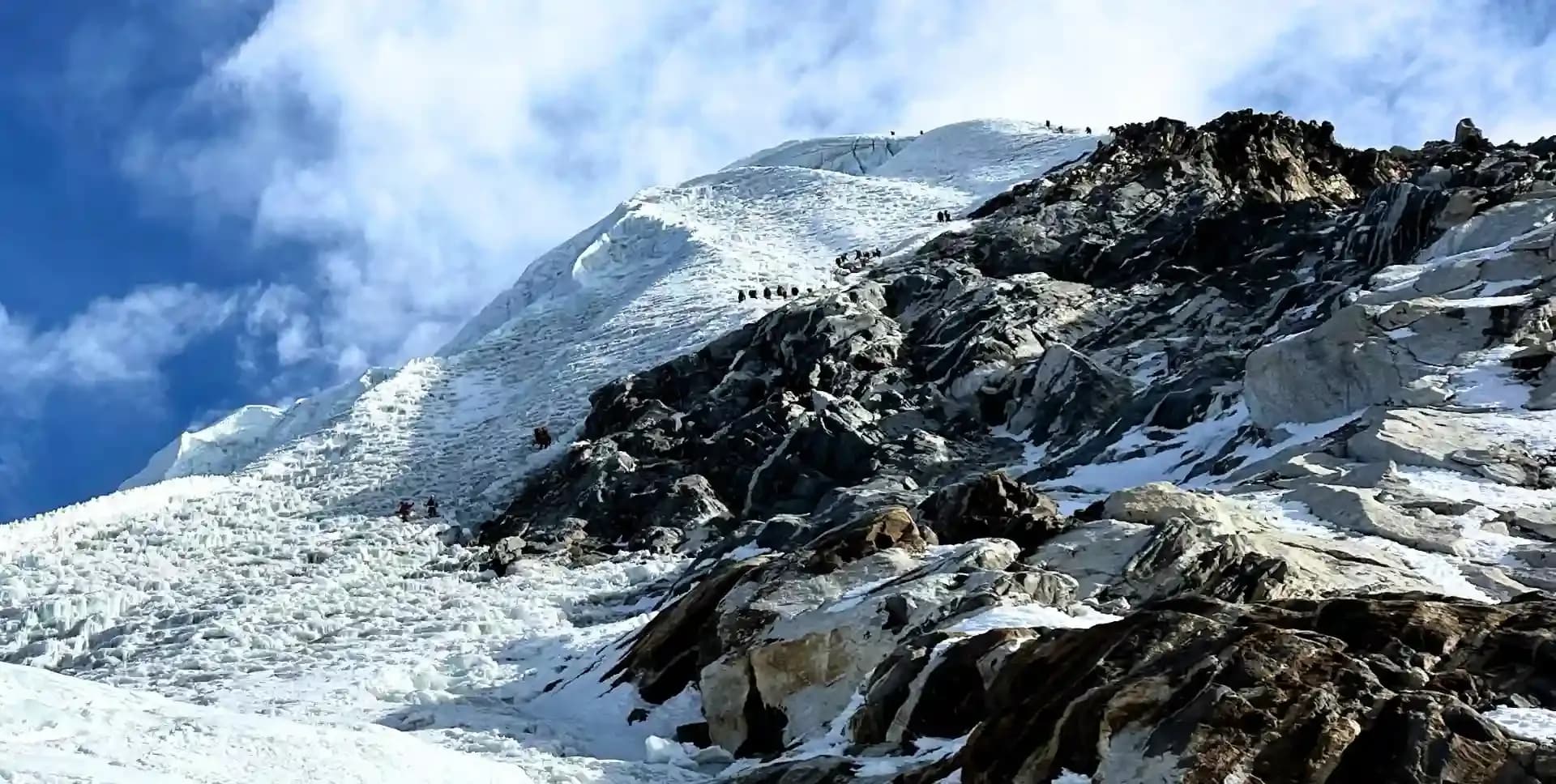
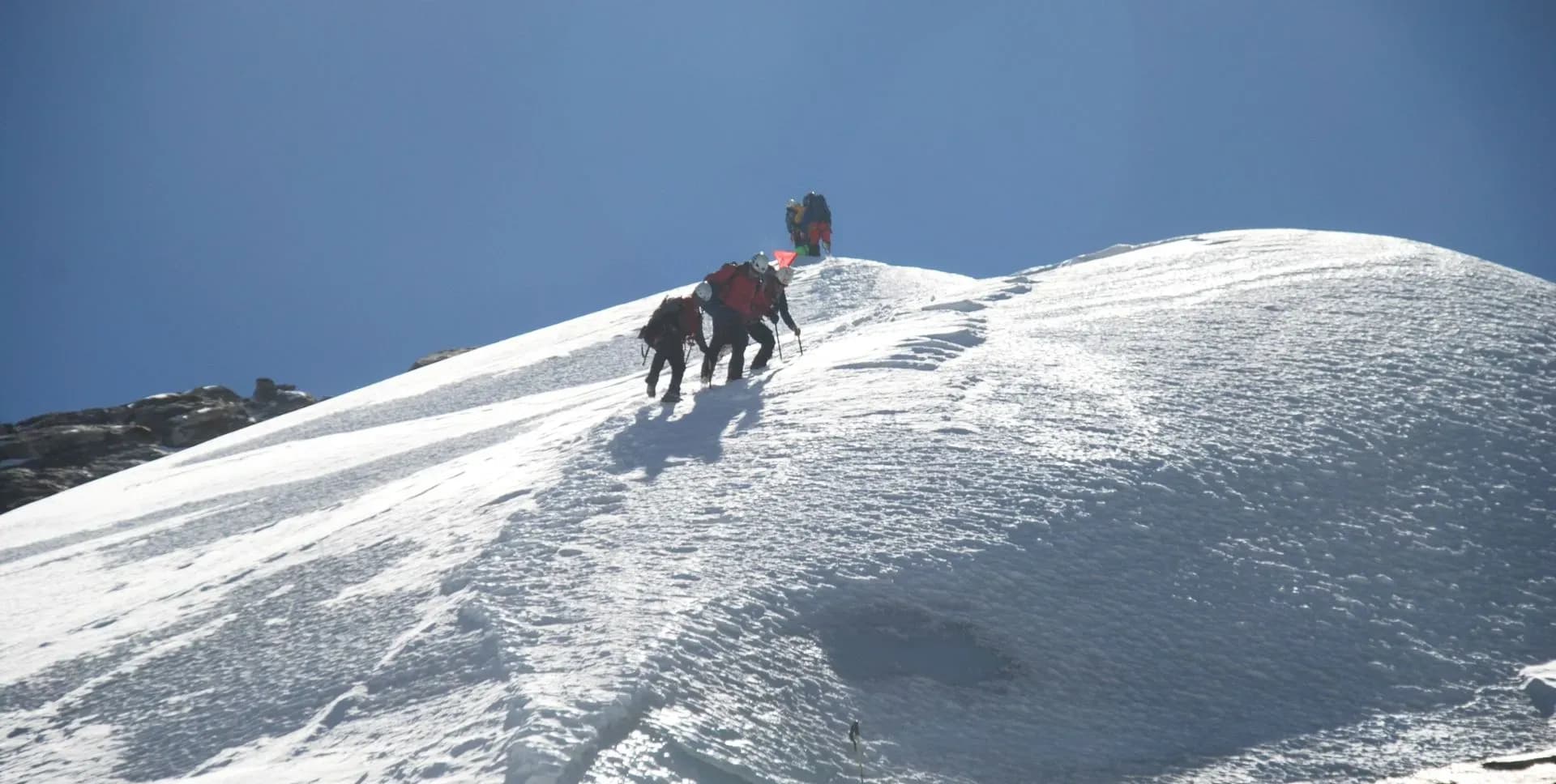
The climb is graded Alpine PD+, which means it is not technically difficult but does demand good fitness, sound acclimatization and confidence on snow and ice. From Base Camp the route climbs grassy slopes and rocky outcrops to a broad gully, then follows an easy ridge onto the glacier. Fixed ropes are set across the crevassed glacier and up the headwall, a snow and ice slope of roughly 150 m that steepens to around 50 degrees, before a short summit ridge leads to the top. You climb with crampons, harness, ice axe and a jumar, a mechanical ascender that grips the fixed rope, and your climbing Sherpa manages the ropes throughout.
This program approaches the peak by way of Everest Base Camp and Kala Patthar, which gives your body an unusually thorough acclimatization schedule. Rest days in Namche Bazaar and Dingboche, hikes to Hotel Everest View and Nangkartshang Peak, and the crossing of Kongma La at 5,535 m all raise your ceiling gradually before you reach Chukkung. By the time you walk into Base Camp you have already slept above 4,900 m for several nights and stood at 5,545 m. That preparation is what turns a strenuous summit day into an achievable one.
Summit day starts around 1 am. You climb by headlamp over moraine and rock, rope up at the edge of the glacier and reach the headwall as the sky lightens. The reward is one of the great viewpoints of the Himalaya: the south face of Lhotse directly overhead, Nuptse and Lhotse Shar forming a wall to the north, Makalu and Baruntse to the east and the fluted ridges of Ama Dablam across the valley. The round trip from Base Camp usually takes ten to twelve hours.
Along the way you walk through the Sherpa heartland, past the monasteries of Tengboche and Pangboche, the trading town of Namche Bazaar and the stone-walled fields of Dingboche. You sleep in family-run lodges as far as Chukkung and in tents at Base Camp. For anyone with solid trekking experience who wants a first Himalayan summit, or a training climb before a bigger expedition, Island Peak offers a real mountaineering experience with a manageable level of risk.
Island Peak Climbing Itinerary
Tap any day to read the full programme.
Your guide meets you in the arrivals hall of Tribhuvan International Airport and drives you to your hotel, a short walk from the shops and restaurants of Thamel. Kathmandu is loud, colorful and a world away from the silence of the high Khumbu, so take the afternoon at your own pace: rest after the flight, wander the lanes near the hotel or sit with a coffee and watch the city go by. In the late afternoon, usually after 5 pm, the team gathers for an introductory meeting where your guide outlines the program, the Lukla flight plan and the days ahead. The evening is free. Aim to land before midday if possible so you have time to settle in before the expedition begins.
Today is set aside for preparation. After breakfast your climbing guide goes through your equipment piece by piece: mountaineering boots, crampons, harness, ice axe, helmet, jumar, down jacket, sleeping bag and the smaller items that are easy to forget. Anything missing or unsuitable can be bought or hired in Thamel, where several shops stock proper climbing gear. The full expedition briefing follows, covering the acclimatization schedule, altitude sickness and how the team manages it, summit-day tactics, the role of your climbing Sherpa and the contingency plan for Lukla flights. Permits and paperwork are finalized, and you pack your duffel for the porters and your daypack for the trail. With the details settled, the rest of the day is free for sightseeing in the Kathmandu Valley or simply relaxing.
The day starts in the small hours with a drive east out of Kathmandu to Manthali airport in Ramechhap, roughly four to five hours on winding hill roads. From here a small aircraft carries you on a short flight to Lukla, threading between ridges before touching down on the famous sloping runway of Tenzing-Hillary Airport. You meet the porters, have tea and set off on the trail. The walk to Phakding is a gentle introduction: the path descends through Chheplung and Ghat, past mani walls, prayer wheels and the first suspension bridges, with the Dudh Koshi roaring below and Kusum Kanguru rising above the valley. Around three hours of easy walking brings you to Phakding, where you settle into a riverside lodge for your first night in the Khumbu.
Following the Dudh Koshi upstream, the trail passes through pine forest and the villages of Benkar, Chumoa and Monjo, where you enter Sagarmatha National Park and your permits are checked. Thamserku appears above the trees, a first real taste of the big peaks. Beyond Jorsale the valley narrows and you cross the high Tenzing-Hillary suspension bridge, strung with prayer flags above the confluence of the Bhote Koshi and Dudh Koshi. Then the work begins: a steady climb of nearly 600 m on forested switchbacks, with a first glimpse of Everest above the Lhotse-Nuptse ridge if the sky is clear. The gradient eases as you approach Namche Bazar, the horseshoe-shaped Sherpa capital with its lodges, bakeries, gear shops and weekend market. Expect about six hours of walking.
Acclimatization works best when you climb high and sleep low, so today you gain over 400 m on a morning hike and return to Namche for the night. The path climbs above the town past the national park headquarters, where Everest, Lhotse, Ama Dablam, Thamserku and the sacred peak of Khumbila line the horizon, then continues over the Syangboche airstrip to Hotel Everest View. From the hotel terrace you sit with a hot drink and look straight up the valley at Everest. On the way down you can detour through Khumjung, a traditional village with a school founded by Sir Edmund Hillary, or return directly to Namche. The afternoon is free for the Sherpa Culture Museum, last-minute shopping or simply resting at the lodge.
Leaving Namche, the trail climbs to a ridge and then contours high above the Dudh Koshi, one of the finest stretches of walking in the Khumbu. Ama Dablam, Everest and Lhotse stay in view for much of the morning, and you may spot Himalayan tahr or musk deer on the slopes. At Kyangjuma the path drops through rhododendron and birch forest to the river at Phunki Tenga, where water-driven prayer wheels turn beside the bridge and you stop for lunch. The afternoon is a steady two to three hour climb through forest to the meadow at Tengboche. The monastery here is the spiritual center of the Khumbu, and you are welcome to attend the afternoon prayer ceremony. Sunset on Ama Dablam from the lodge door is worth the climb alone.
The morning view from Tengboche, with Kangtega, Thamserku, Ama Dablam and the Lhotse-Nuptse wall catching the first light, sets the tone for the day. You descend through forest to Deboche, cross the Imja Khola and climb to Pangboche, where the oldest monastery in the Khumbu, founded in the seventeenth century, sits among juniper above the village. Beyond Shomare the trees give way to alpine scrub and yak pasture, and the valley opens out. Ama Dablam looms closer with every step, and Island Peak shows itself for the first time at the head of the Imja Valley. Crossing the river at Tsuro Wog, a final climb brings you to Dingboche, a village of stone-walled fields and sunlit lodges. Allow five to six hours of walking.
Your second acclimatization day follows the same principle as the first: climb high, sleep low. The path zigzags up the ridge directly north of Dingboche, steepening as it goes, and you gain nearly 700 m over the morning. It is a strenuous hike at this altitude, but a valuable one. From the prayer flags on top of Nangkartshang the panorama takes in three of the world's six highest mountains, Lhotse, Makalu and Cho Oyu, along with Taboche, Cholatse, Pokalde and the rarely seen north side of Ama Dablam. Best of all, you look directly across at Island Peak and the route you will follow in a few days' time. You return to Dingboche for lunch, then spend the afternoon resting, hydrating and letting your body adjust.
The trail climbs out of Dingboche onto a broad terrace above the Khumbu Khola, with Taboche and Cholatse on your left and Lobuche Peak ahead. It is high, open country now, treeless and wild, and the walking is gentle until you drop to a wooden bridge and climb to Dughla for lunch. From here the path rises steeply up the moraine of the Khumbu Glacier to Chukpi Lhara, where stone memorials and prayer flags honour climbers who lost their lives on Everest. The gradient eases as you follow the glacier's edge beside a stream, with Pumori, Lingtren and Khumbutse now standing on the Tibetan border ahead. Lobuche is a cold, stark place at nearly 5,000 m; drink plenty of fluids and take the afternoon easy.
An early start takes you up the rocky moraine beside the Khumbu Glacier, over the boulders of Thangma Riju and across the uneven debris of the Changri Glacier to Gorakshep, a sandy former lakebed with a handful of lodges. After dropping your bags and eating, you continue to Everest Base Camp. The trail follows the lateral moraine and then winds down among ice pinnacles and glacial pools to the camp itself, with the Khumbu Icefall tumbling from the Western Cwm above. Everest is hidden behind Nuptse, but the sense of scale is extraordinary, and in spring the site is busy with expedition tents. After time to take it all in, you retrace the route to Gorakshep for the night. This is a long day of seven to eight hours at high altitude.
You leave the lodge before dawn by headlamp and climb the steep ridge of Kala Patthar, the highest point of the trek before the summit itself. The last stretch involves scrambling over boulders and the cold is sharp, but as the sun rises the whole of Everest appears, from the summit pyramid down to the Icefall, with Nuptse, Lhotse, Pumori and Changtse arranged around it. This is the classic Everest viewpoint, and the closest you can get to the mountain without climbing it. You return to Gorakshep for breakfast, pack up and descend the familiar moraine trail to Lobuche. Having now slept and walked at 5,000 m and above, your body is well prepared for the climbing phase ahead. Allow six to seven hours in total.
The crossing of Kongma La is the most demanding trekking day of the program and the final big step in your acclimatization. From Lobuche you cross the rubble-covered Khumbu Glacier, then climb grassy hillside and long scree switchbacks to the pass. The top is quiet, marked by cairns and prayer flags, with a sweeping view back over Pumori, Lobuche Peak and the Khumbu, and Makalu appearing to the east. A frozen lake lies just below the crest. The descent is long and rocky, passing between Pokalde and the flanks of Nuptse before easing into the Imja Valley and the small settlement of Chukkung. Here you meet your climbing Sherpa team and the camping crew. Allow seven to nine hours of walking.
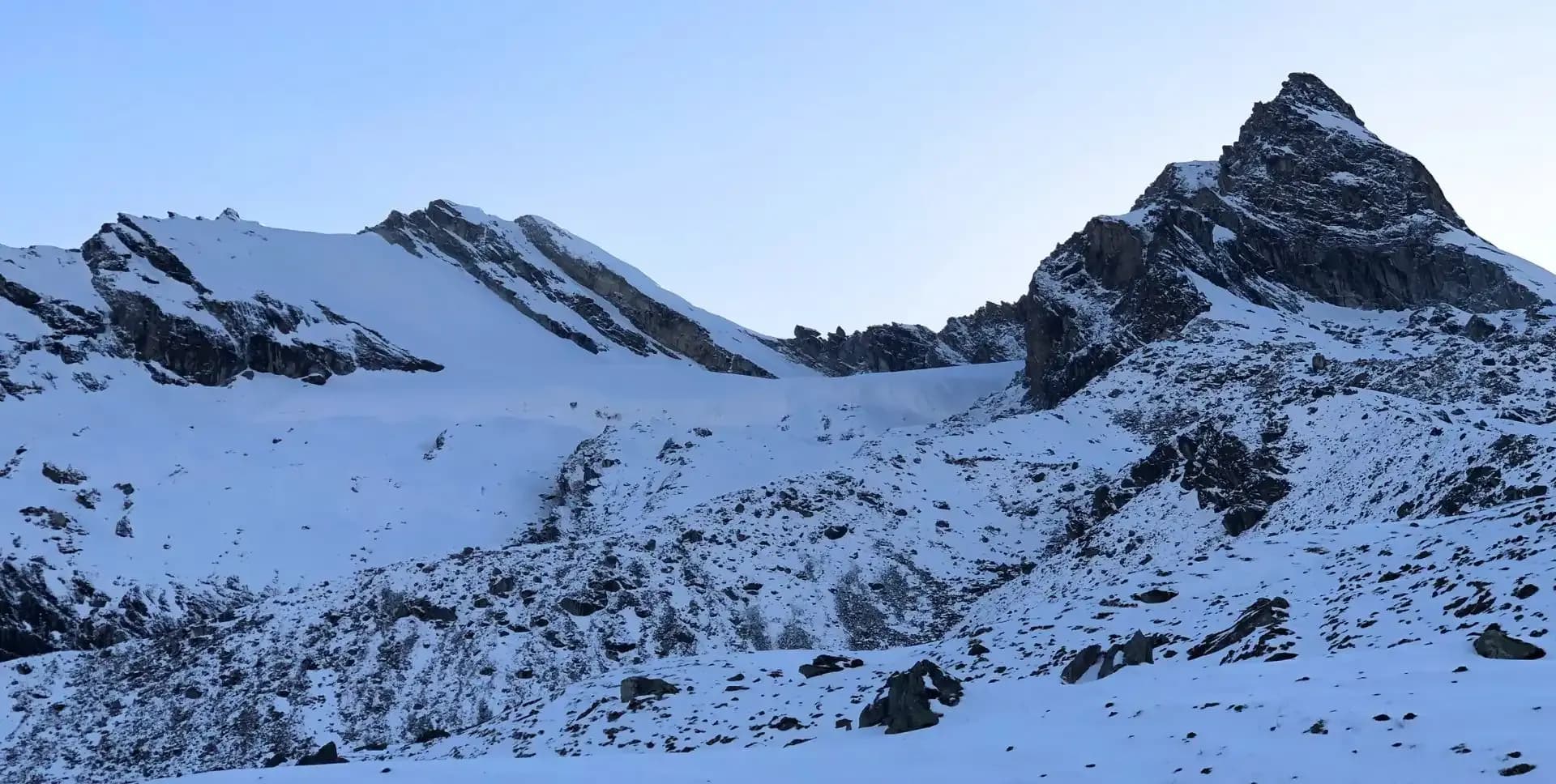
The morning is spent on climbing preparation at Chukkung. Your Sherpa guide runs a practical session on fitting crampons, using the jumar and abseil device on a fixed rope, and moving as a roped team, so that every technique is familiar before you need it in the dark. After lunch you walk up the Imja Valley, first over the moraine left by the Lhotse and Imja glaciers, then across a dry lakebed and up grassy slopes to Base Camp at Pareshaya Gab. Nuptse and Lhotse fill the northern skyline and the ice of the Imja Glacier lies close beside you. The camp is a cluster of sleeping tents with a dining tent and kitchen. Dinner is early, the guide gives a final briefing, and you are in your sleeping bag by dusk.
A knock on the tent comes around midnight. After tea and a light breakfast you set off at about 1 am, climbing by headlamp up steep grass and rock, past the ledges of the high camp and across a broad gully onto the ridge. At the edge of the glacier you put on crampons and harness and rope up. The glacier climbs gradually, weaving around crevasses on fixed lines, until the headwall rises in front of you as dawn breaks. Clipping your jumar to the rope, you climb the 150 m snow and ice slope to the summit ridge, then follow it to the top. The south face of Lhotse towers overhead, with Nuptse, Makalu, Baruntse and Ama Dablam all around. After photographs you abseil the headwall and return to Base Camp, usually by early afternoon.
After the intensity of summit day, this is a day of relief and thickening air. You break camp and walk back down the Imja Valley to Chukkung, where the climbing team packs up and you say goodbye to the Sherpas who fixed the ropes. The trail then follows the river down past Bibre to Dingboche and on through Shomare as the first juniper and shrubs reappear on the hillsides. Every hour brings more oxygen, and legs that felt heavy at Base Camp move easily again. Ama Dablam stands directly ahead for much of the afternoon. You cross the Imja Khola and arrive at Pangboche, with its ancient monastery and stone houses, for a well-earned lodge dinner and a warm night's sleep below 4,000 m.
This is a long descent day, and a beautiful one. From Pangboche you drop through the forest at Deboche to Tengboche, where the monastery ridge gives one last view of Everest, then descend steeply to Phunki Tenga and climb back up to Kyangjuma. The high traverse above the Dudh Koshi brings you into Namche Bazar for lunch. In the afternoon you continue down the forested switchbacks, cross the Tenzing-Hillary bridge and follow the river out of the national park at Monjo, passing Benkar and the waterfall at Toktok before reaching Phakding. Expect eight to nine hours on the trail. Warm air, greenery and the sound of the river make a striking contrast with the ice of only two days ago.
The final walking day is short and relaxed. The trail climbs gradually from Phakding through Ghat and across the Thado Koshi bridge beneath Kusum Kanguru, then passes Chheplung and Chaurikharka, where Sir Edmund Hillary's Himalayan Trust built its first school. A last uphill stretch leads through the kani gateway into Lukla, and the trek is complete. The afternoon is free to explore the town, sort your gear or enjoy a hot shower. In the evening the team celebrates with a farewell dinner, and it is customary to thank the porters and assistant guides who carried loads and looked after you for the past two weeks. Your guide confirms the morning flight details before you turn in.
Lukla flights leave early, when the mountain weather is at its most settled, so you are at the airport soon after dawn. The short flight to Ramechhap gives a final look at the foothills before the drive back to Kathmandu, arriving in the early afternoon. Check into the hotel and take a long shower. The rest of the day is free: relax, browse the shops of Thamel for souvenirs or book a sightseeing tour for tomorrow. In the evening we arrange a celebration dinner at one of Kathmandu's restaurants, a chance to reflect on the climb with your guide and the team over good food. In the quieter seasons Lukla flights sometimes operate directly to and from Kathmandu instead of Ramechhap.
Lukla weather can close the airstrip for hours or days at a time, and this spare day exists so that a delay in the mountains does not cost you your international flight. If the schedule has run smoothly, the day is yours to enjoy Kathmandu. The valley holds seven UNESCO World Heritage sites, including the stupas of Boudhanath and Swayambhunath, the temple complex of Pashupatinath and the medieval Durbar Squares of Kathmandu, Patan and Bhaktapur, and a guided tour of two or three of these makes a rewarding day. Alternatively, rest and let the achievement sink in. In the evening we host a farewell dinner with your guide and office staff, and welcome your feedback on the expedition.
Your Island Peak program ends today. After breakfast and checkout, which most Kathmandu hotels require by noon, your guide or a member of our office team meets you in the lobby and drives you to Tribhuvan International Airport. Plan to leave the hotel around three hours before your international departure. If your flight is later in the day, the morning is free for last-minute shopping or a final walk through Thamel.
Island Peak Climbing Route Map
Route Map
Altitude Profile
Inclusions
• Private airport transfers in Kathmandu (arrival & departure)
• 4 nights at a 3-star Kathmandu hotel (twin-share, bed & breakfast)
• Round-trip Kathmandu/Ramechhap–Lukla flights with standard baggage allowance
• 13 nights twin-share lodge accommodation during the trek
• 2 nights at Island Peak High Camp with full-board meals and unlimited hot drinks
• Full-board meals throughout the trek (breakfast, lunch, dinner, tea & coffee)
• Drinking water and hot water for bottle refills at all lodge stops
• All required trekking permits (Sagarmatha National Park & Khumbu Pasang Lhamu Rural Municipality)
• Island Peak climbing permit, including all associated fees and garbage deposit
• Personal senior English-speaking, government-licensed climbing guide, fully covered (wages, meals, transportation, accommodation & insurance)
• One porter per client (max 30 kg/client), fully covered
• Emergency medical kit throughout the trek
• Supplemental oxygen, mask & regulator for emergency use
Exclusions
• International airfare to/from Kathmandu
• Nepal entry visa fee
• Personal travel, medical & emergency evacuation insurance (mandatory; arrange prior to departure)
• Lunch & dinner in Kathmandu
• Additional Kathmandu nights beyond the itinerary (available on request)
• Single room supplement or forced single room charges, where applicable
• Personal trekking & climbing gear (sleeping bag, boots, trekking poles, down jacket, harness, crampons, etc.)
• Alcoholic beverages, specialty hot drinks & bottled/canned drinks during the trek
• Lodge extras charged locally: hot showers, battery charging & Wi-Fi
• Island Peak summit bonus of USD 300 for the climbing guide
• Any personal expenses not listed under inclusions
• Climbing guide & porter gratuities (recommended: USD 200/climbing guide, USD 120/porter — at client's discretion)
Date & Price
Want a Private or Tailored Trip?
Book on your own dates, bring a private group, or adjust the itinerary. Our team replies within 24 hours.
Reviews
Write a review
No reviews yet. Be the first to share your experience.
Gallery
No gallery images available.
From (per person)
People also viewed